Editorial review: Async Innovations Engineering Team. Technical and market-sensitive claims are reviewed against primary documentation where available.
A 2026 Python Data Stack Is a Toolkit, Not a Ranking
There is no ...A 2026 Python Data Stack Is a Toolkit, Not a Ranking
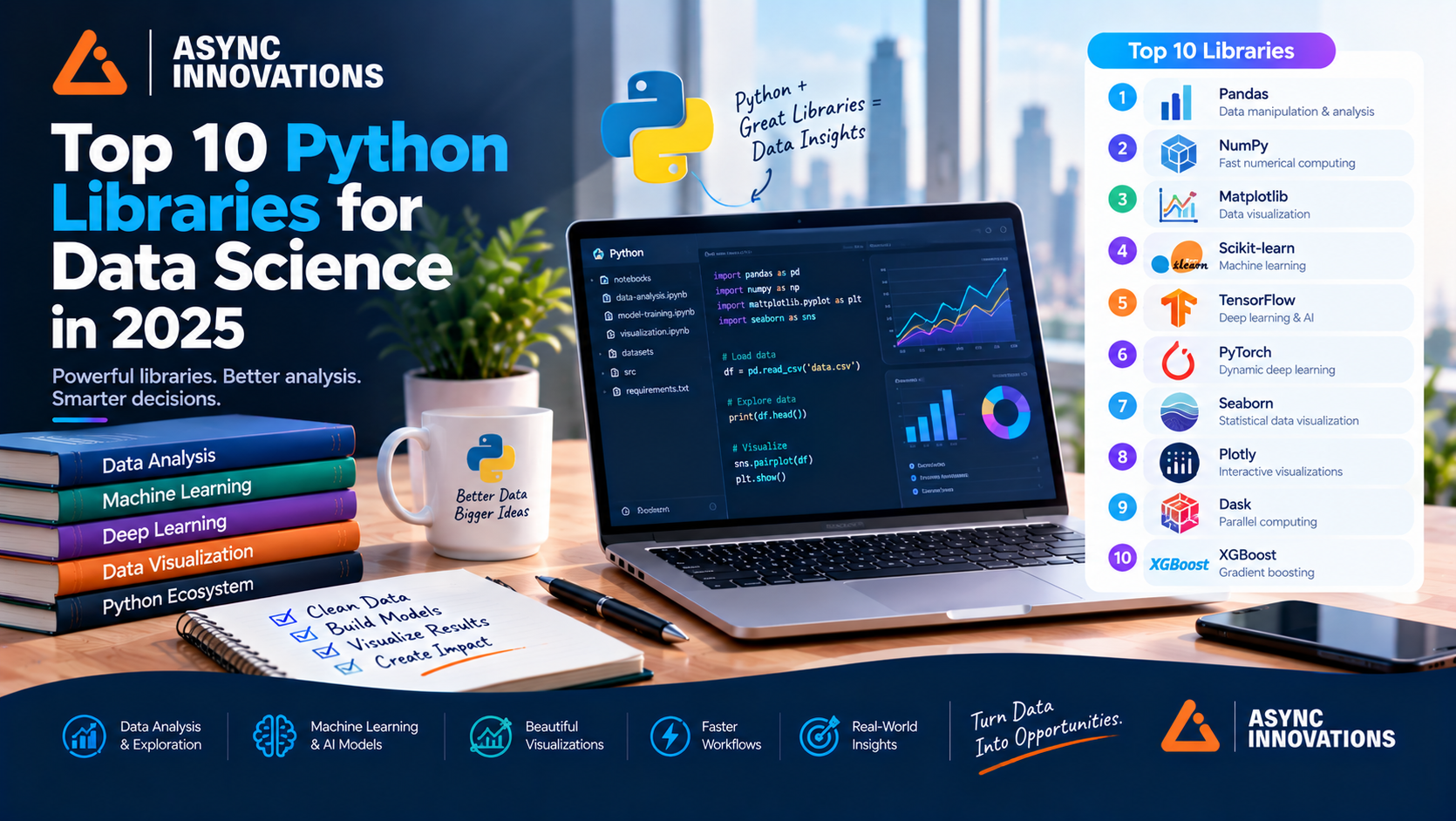
There is no universal list of libraries every data team must use. The right stack depends on whether the work is tabular analysis, statistical modelling, machine learning, deep learning, natural-language processing, visualization or production inference. A practical 2026 shortlist is NumPy, pandas, Matplotlib, SciPy, scikit-learn, PyTorch, TensorFlow/Keras, Hugging Face Transformers, Polars and Plotly.NumPy remains foundational for numerical arrays. pandas remains central for labelled tabular data; its official documentation shows the actively maintained 3.x line in 2026. SciPy adds scientific routines, while scikit-learn provides a mature API for classical machine learning and preprocessing.
PyTorch and TensorFlow/Keras serve deep-learning workloads. Hugging Face Transformers is useful when teams need pretrained transformer models and related tooling. Polars is an alternative dataframe engine worth evaluating for suitable workloads, while Matplotlib and Plotly cover static and interactive visualization needs.