Editorial review: Async Innovations Engineering Team. Technical and market-sensitive claims are reviewed against primary documentation where available.
AI in Health Is Already Broader Than Clinical Diagnosis
AI is bei...AI in Health Is Already Broader Than Clinical Diagnosis
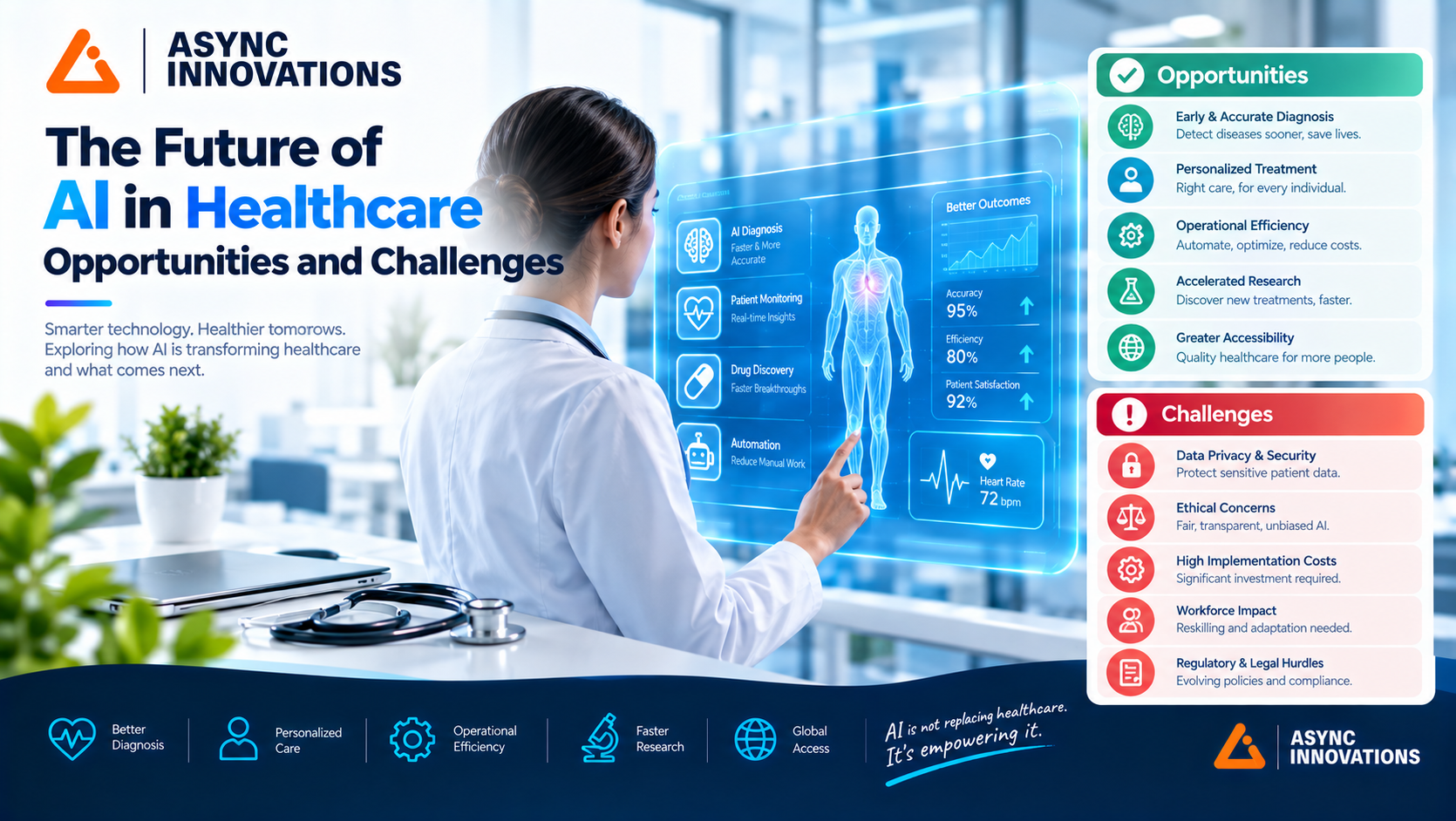
AI is being explored across diagnosis and clinical care, research, drug development, disease surveillance and health-system management. The World Health Organization describes both the opportunity and the need for evidence-based, safe and equitable adoption.For many organizations, lower-risk starting points may be administrative rather than diagnostic: document classification, knowledge retrieval, scheduling support, operational forecasting or drafting assistance. Our AI development and AI analytics work starts by separating these workflow-support cases from systems that could influence clinical decisions.
Healthcare Raises the Evidence Bar
Accuracy alone is not enough. Teams need to consider data quality, privacy, bias, explainability where relevant, human oversight, security, monitoring and the regulatory status of the intended use. WHO's guidance on large multi-modal models for health emphasizes governance and risk considerations for generative AI in healthcare.A Responsible Implementation Path
Define the exact intended use, identify who is accountable for decisions, establish the data and privacy basis, validate performance on representative users and edge cases, and keep monitoring after deployment. For UAE deployments processing personal data, teams should also assess applicable obligations under the UAE's Personal Data Protection Law framework rather than treating “AI compliance” as a single checklist.Healthcare software can combine these controls with custom software engineering, but clinical or regulated use requires domain-specific legal, clinical and regulatory review beyond general software development.