Editorial review: Async Innovations Engineering Team. Technical and market-sensitive claims are reviewed against primary documentation where available.
Both Frameworks Are Active—Choose for Your Product and Team
React...Both Frameworks Are Active—Choose for Your Product and Team
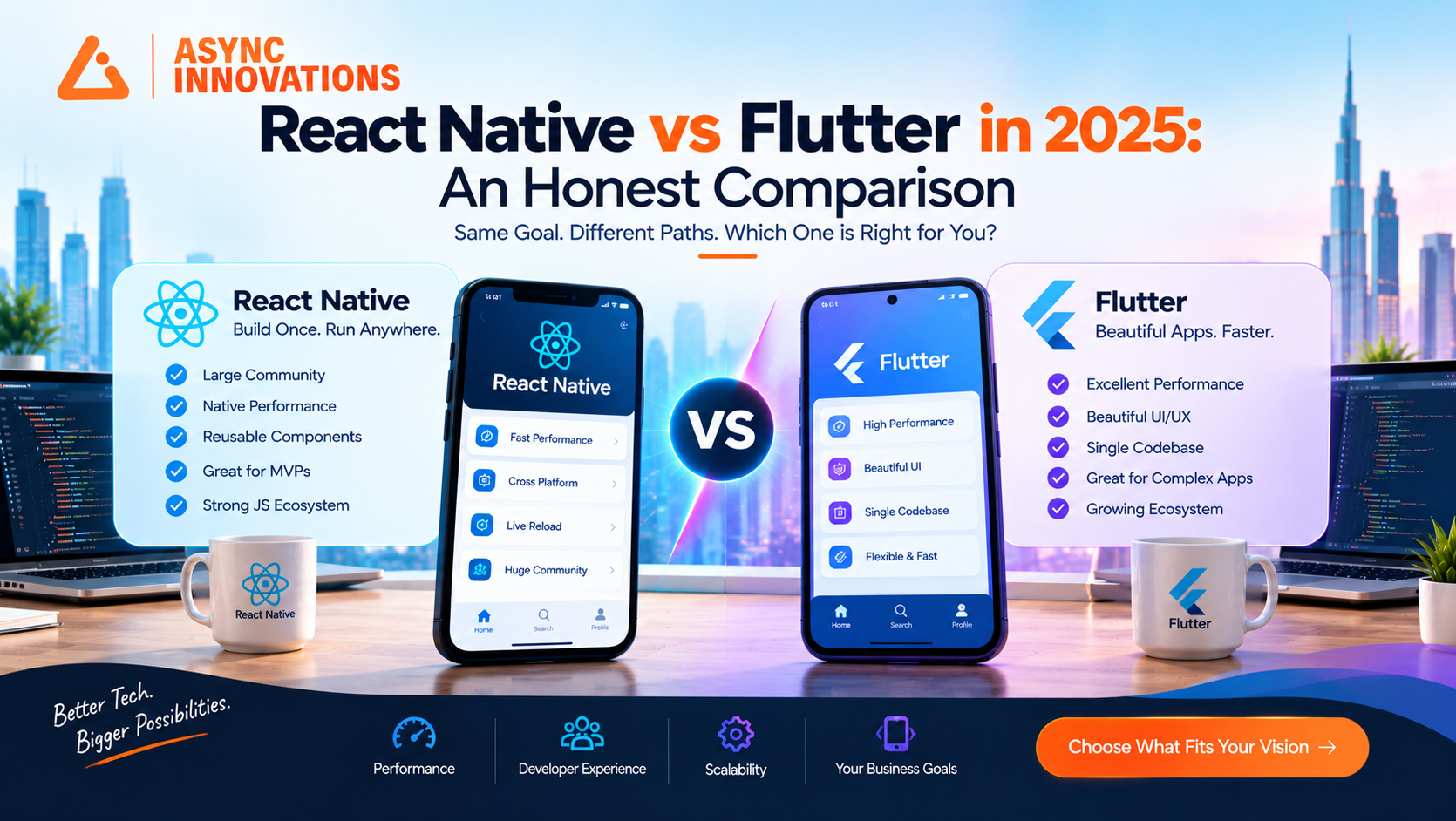
React Native and Flutter remain actively developed cross-platform frameworks in 2026. The official React Native release schedule shows active 2026 releases, while Flutter's stable release notes document its current release line. That makes “which framework is alive?” the wrong question; the useful question is which trade-offs fit your application.At Async Innovations, our mobile app development work can use either approach when appropriate. We do not recommend choosing a framework from a generic benchmark alone.
React Native Is Often a Strong Fit When
Your team already has deep React/TypeScript experience; you want to share knowledge with a React web stack; or your required native SDKs have mature React Native support.Flutter Is Often a Strong Fit When
You value a highly controlled cross-platform UI layer, your team is comfortable adopting Dart, or Flutter's widget/tooling ecosystem aligns better with the product and supported targets.Compare the Risks That Actually Affect Delivery
Review plugin/SDK availability, native-module requirements, accessibility, Arabic/RTL behavior, application size, CI/CD, testing strategy, upgrade cadence and the skills of the team that will maintain the product. Test any performance-critical flow on representative devices rather than relying on a universal FPS claim.Do not assume Flutter requires a fixed 20–30% less effort for RTL, or that either framework is always faster or cheaper. Those outcomes depend on the design system, dependencies and team experience. Build a small technical spike when one requirement could decide the architecture.
The best framework is the one that satisfies the product's constraints while leaving the team with a maintainable application after launch.