Editorial review: Async Innovations Engineering Team. Technical and market-sensitive claims are reviewed against primary documentation where available.
RAG and Fine-Tuning Solve Different Problems
Retrieval-Augmented ...RAG and Fine-Tuning Solve Different Problems
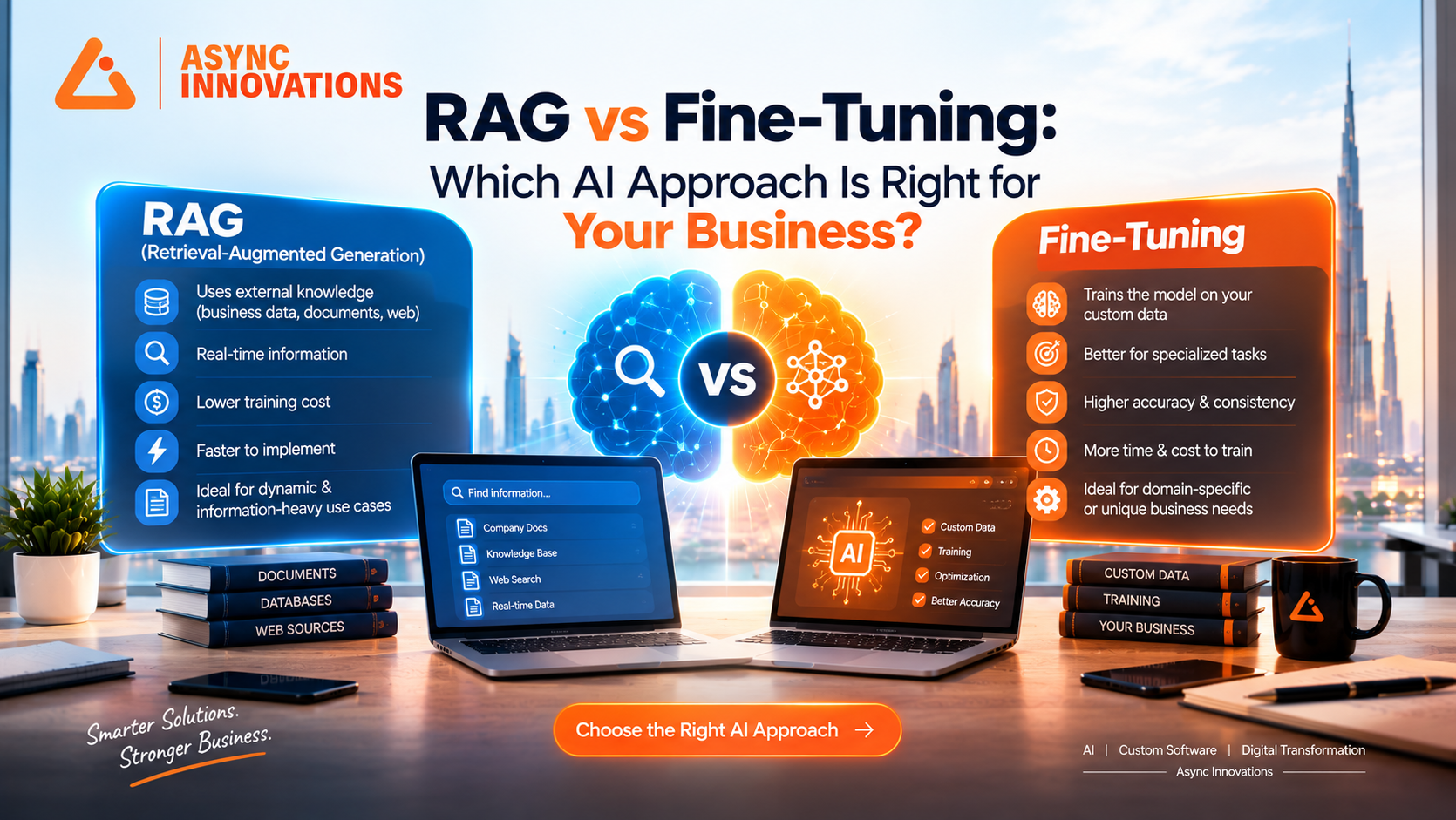
Retrieval-Augmented Generation (RAG) retrieves relevant information from external sources and supplies that context to a model at request time. Google Cloud's RAG overview describes this combination of information retrieval and generative models. It is useful when answers need access to changing, proprietary or sourceable knowledge.Fine-tuning updates a model using additional training examples. It can be useful when the goal is to shape task behaviour, output structure, style or performance on a sufficiently well-defined task. It should not be treated as a substitute for a knowledge store that changes frequently.
Use a Decision Framework Instead of a Percentage Rule
Choose RAG when the answer must reflect current documents, product data, policies or other retrievable sources. Consider fine-tuning when repeated examples can teach a stable behaviour that prompting alone does not achieve reliably. Use both when the system needs grounded knowledge and specialized behaviour. In some cases, neither is necessary: a well-designed prompt plus tools may be enough.The right choice should be tested with an evaluation set representing real user requests. Measure retrieval quality, answer correctness, unsupported claims, latency and cost. For higher-risk generative-AI systems, the NIST Generative AI Profile is a useful governance reference.