Editorial review: Async Innovations Engineering Team. Technical and market-sensitive claims are reviewed against primary documentation where available.
What an AI Agent Actually Is
An AI agent is a software system des...What an AI Agent Actually Is
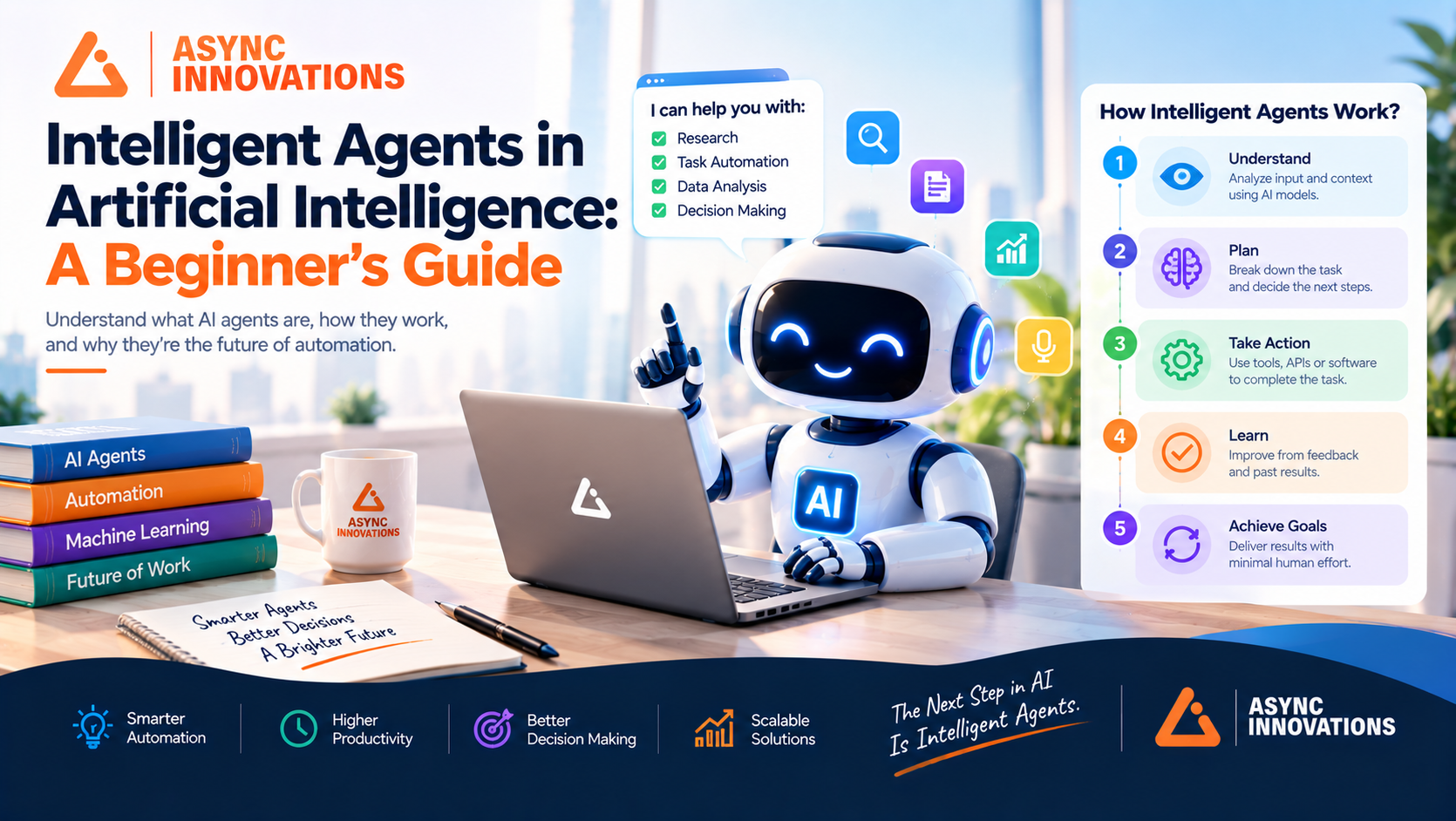
An AI agent is a software system designed to observe context, reason about a goal, choose actions and use tools or external systems to complete part of a workflow. The important distinction from a conventional chatbot is not simply that an agent uses an LLM: an agent can combine model reasoning with application state, APIs, retrieval, business rules and controlled actions.A Practical Agent Architecture
A production agent normally needs more than a prompt. Typical layers include an interface, an orchestration layer, access to approved tools, retrieval or application data, permissions, logging, evaluation and a human-escalation path. That is why agent work often overlaps with our AI development, API & cloud and custom software work.Where Agents Fit — and Where They Do Not
Good candidates have a clear goal, bounded tools, observable outcomes and an escalation path: for example, classifying an incoming request, retrieving account context, drafting a response, or coordinating a defined back-office workflow. High-impact actions should not be made autonomous merely because a model can call a tool. Permissions, approval rules and auditability should match the risk of the action.The NIST Generative AI Profile provides a useful risk-management reference for designing and evaluating generative-AI systems. In practice, teams should test agent quality against representative tasks, failure cases and tool-permission boundaries before expanding autonomy.