Editorial review: Async Innovations Engineering Team. Technical and market-sensitive claims are reviewed against primary documentation where available.
Building a Product Around Real Business Workflows
SIYNEX is an As...Building a Product Around Real Business Workflows
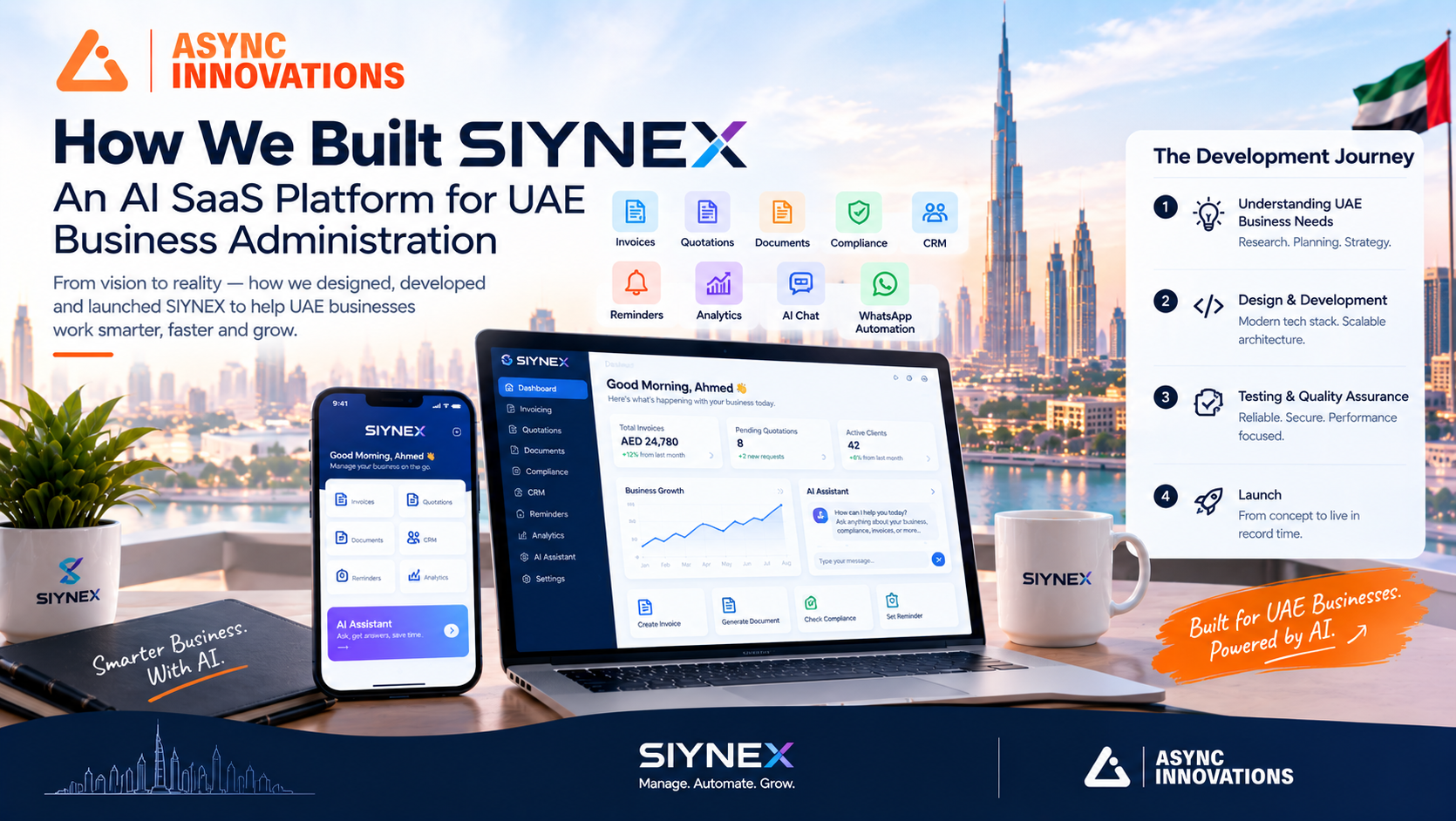
SIYNEX is an Async Innovations SaaS product built to bring recurring business operations into one connected workspace. Its current scope includes AI-assisted workflows, quotations, invoicing, reminders, client management, business documents, analytics and business/tax-related operational tooling.The useful engineering lesson is not a claimed percentage improvement. It is how product, AI and business workflows have to connect so users can move from information to an actual business action without maintaining disconnected tools.
Architecture Decisions
The platform uses a TypeScript-oriented web application architecture with a structured backend, relational data and AI-assisted capabilities. We separate deterministic business records and permissions from generative-AI behavior so that invoices, quotations, customer records and other operational data do not depend on an AI response being correct.AI features are treated as assistance inside defined workflows. Where an output can affect business data or communication, the surrounding product flow, permissions and user controls matter as much as the model itself. We do not publish a universal OCR or AI-accuracy percentage because accuracy depends on the task, input quality, model and evaluation set.
What Product Development Taught Us
A business SaaS grows through connected domains: customer data affects quotations and invoices; documents and reminders need ownership and permissions; analytics depends on reliable underlying records; and AI features need clear boundaries around what they can read, draft or change. Those dependencies influence architecture long before they appear in the interface.We also learned to treat regulatory and tax-related functionality as product requirements that require verification, not as marketing labels. Rules, calculations and user-facing explanations need their own review and testing lifecycle.