Editorial review: Async Innovations Engineering Team. Technical and market-sensitive claims are reviewed against primary documentation where available.
A Good Brief Reduces Assumption, Not Discovery
A vague brief can ...A Good Brief Reduces Assumption, Not Discovery
A vague brief can produce quotes for several different imagined products. A useful brief gives vendors a common starting point while leaving room for them to challenge assumptions and identify risks. The goal is not to specify every technical decision before speaking to an engineering team; it is to make scope and uncertainty visible.Ten Sections to Include
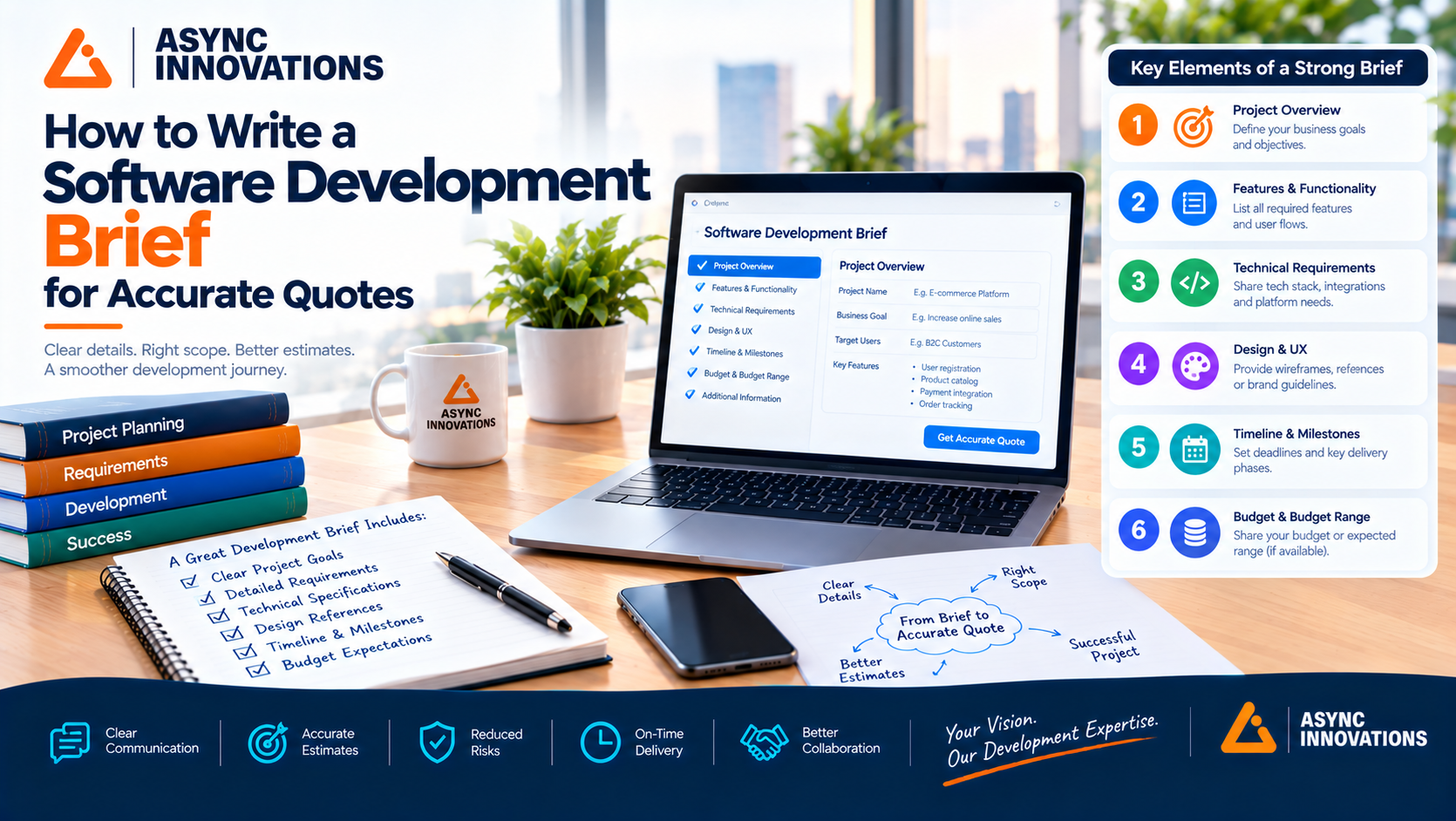
1. Problem and outcome — who has the problem, how it is handled today and what should improve.2. Users and roles — describe actual roles, permissions and important differences between them.
3. Core journeys — state what users need to accomplish, with acceptance criteria for the highest-risk flows.
4. Explicit exclusions — identify what is not part of the first release.
5. Platforms and constraints — web/mobile targets, browsers/devices, existing systems and mandated technologies where they genuinely exist.
6. Integrations and data — external systems, migration sources, APIs, file formats and ownership of credentials/data.
7. Timeline constraints — distinguish a real external deadline from a preferred target date.
8. Budget context — a range can help vendors design an appropriate scope, but pair it with priorities rather than treating the ceiling as the specification.
9. Success measures — define observable outcomes such as processing time, completion rate, error reduction or adoption.
10. Regulatory and market requirements — language/RTL, accessibility, payment, security, data location or privacy requirements that actually apply to the product.
Ask Vendors to Expose Their Assumptions
For each quote, request scope, exclusions, named roles, estimated effort or milestones, dependencies, QA, security, deployment, warranty/support and change-control approach. When quotes differ materially, compare assumptions before comparing totals.A brief should also state what is still unknown. That gives discovery a clear purpose and prevents false precision in the estimate.
Our custom software development team can review an existing brief or help turn a business problem into a scoped first release through our consulting process.