Editorial review: Async Innovations Engineering Team. Technical and market-sensitive claims are reviewed against primary documentation where available.
Rebuild When the Evidence Beats the Migration Cost
A rebuild is n...Rebuild When the Evidence Beats the Migration Cost
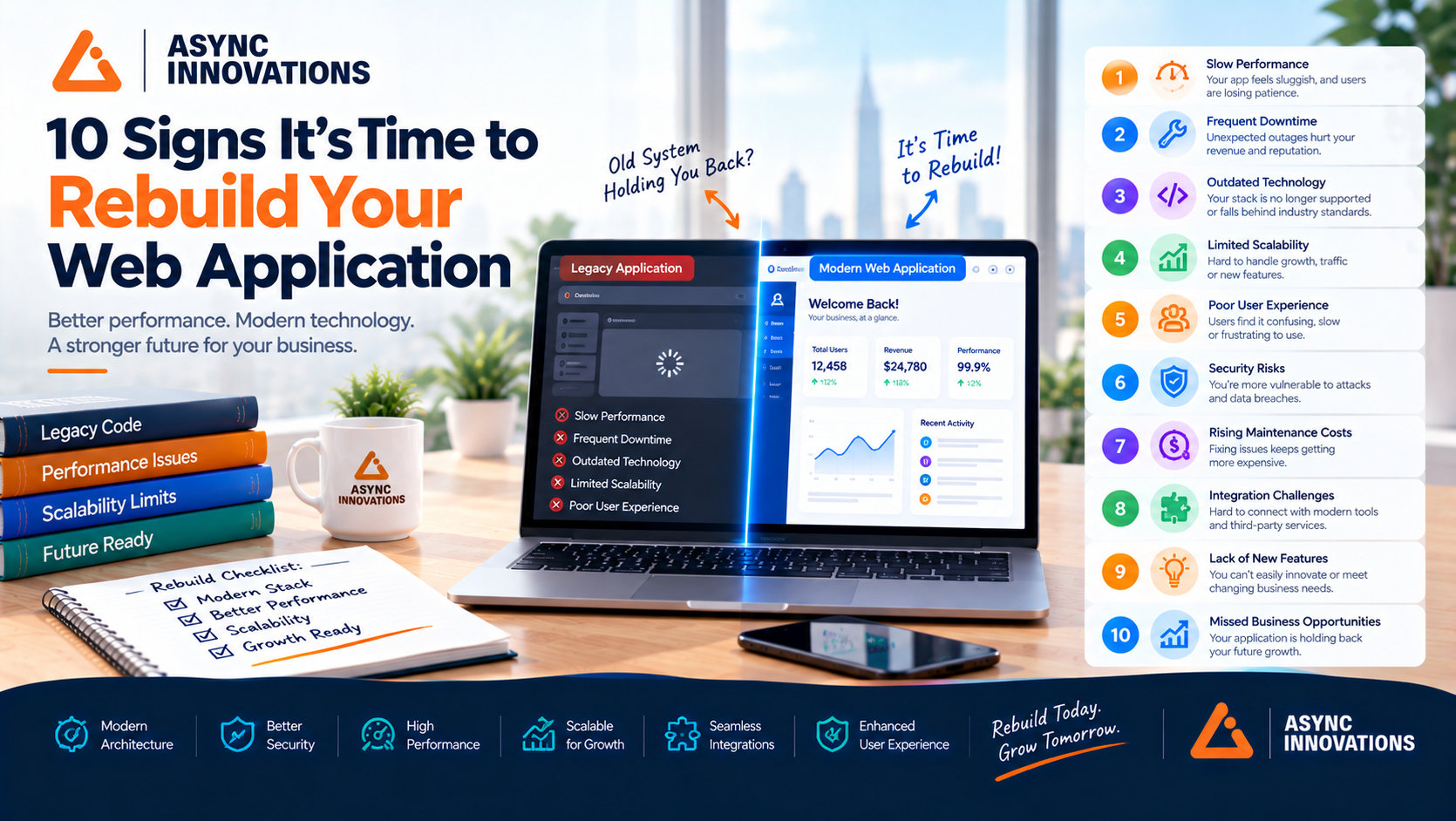
A rebuild is not automatically better than incremental modernization. The decision becomes credible when the current system creates repeated delivery, security, reliability or product constraints that cannot be addressed economically in place.Ten Signals Worth Investigating
1. Changes repeatedly cause regressions. Measure defect escape rate and the parts of the system that require disproportionate retesting.2. Performance degrades as real usage grows. Profile database, network, rendering and infrastructure bottlenecks before blaming the entire architecture.
3. Critical knowledge exists only in people's heads. Missing documentation and tests make maintenance and onboarding fragile.
4. Core dependencies are unsupported. End-of-life runtimes or frameworks can lose security fixes and ecosystem compatibility. Verify support status from the relevant maintainers rather than using a permanently fixed version list.
5. Maintenance crowds out product delivery. Track actual engineering capacity spent on incidents, regressions and workarounds; there is no universal 40% threshold that mandates a rebuild.
6. New channels require repeated workarounds. Mobile apps, partner integrations or APIs may expose architectural limitations, but targeted backend modernization can sometimes solve them without a full rewrite.
7. Security issues cannot be remediated reliably. Unsupported dependencies, weak authorization or missing release controls are reasons for urgent remediation. For UAE personal data, assess the applicable data-protection obligations; do not assume an old framework alone determines legal compliance.
8. UX limitations block measurable user goals. Use analytics, support issues and usability evidence rather than competitor appearance alone.
9. Tests, observability and deployment controls are missing. These may be added incrementally, but their absence raises the cost of every risky change.
10. The architecture blocks required product change. Document the blocked roadmap items and compare modernization, strangler migration and full rebuild options.